
GP-B Mission News
On this page:
- Gravity Probe B's 20-year Launch Anniversary Reunion April 20th, 2024
- May 2011: Francis Everitt Awarded the Austrian Cross of Honour for Science and the Arts, First Class
- March 2010: Everitt & Penrose awarded 2010 Trotter Prize
- Fall 2008: GP-B Animations win Telly Award
- Spring 2008: Video of Everitt's talk at Aero-Astro 50th Anniversary Celebration
Gravity Probe B’s 20-year Launch Anniversary Reunion April 20th, 2024

Gravity Probe B team reunion at Stanford on April 20, 2024, celebrating the 20th anniversary of the GP-B spacecraft launch. Click image to enlarge.
Stanford University’s Hansen Experimental Physics Lab hosted a Reunion for the GP-B Program on April 20th, 2024. This marked exactly 20 years since the launch of the spacecraft. Attendees included many ex - NASA, Lockheed and Stanford employees as well as spouses and other guests.
There was much sharing of stories of the program and reuniting with old colleagues. There was also a BBQ lunch prepared by Jimmy V’s Catering. Highlights of the event included presentations by Rex Geveden, Brad Parkinson, Sasha Buchman, John Turneaure and Tom Langenstein as well as a poem from Gaylord Green.
Gravity Probe B 20-Year Reunion Presentation PDFs
Click on a presentation thumbnail image below to open/view that PDF presentation file.
| Tom Langenstein Agenda & Update |
Sasha Buchman & John Turneaure GP-B Overview & Results |
Brad Parkinson The People of GP-B |
|---|---|---|

|

|

|
GP-B Website Image Gallery and 2024 Reunion Participant Photos Slideshows
Click on either of the Play Slideshow buttons to view that slideshow video on YouTube.
| GP-B Image Gallery Slideshow | GP-B 2024 Launch Reunion Participants Slideshow | GP-B Reunion Photo Album |
|---|---|---|

|

|

|
Gaylord Green's Poem to the GP-B Team

Click the image above to enlarge.
Francis Everitt Awarded the Austrian Cross of Honour for Science and Art, First Class
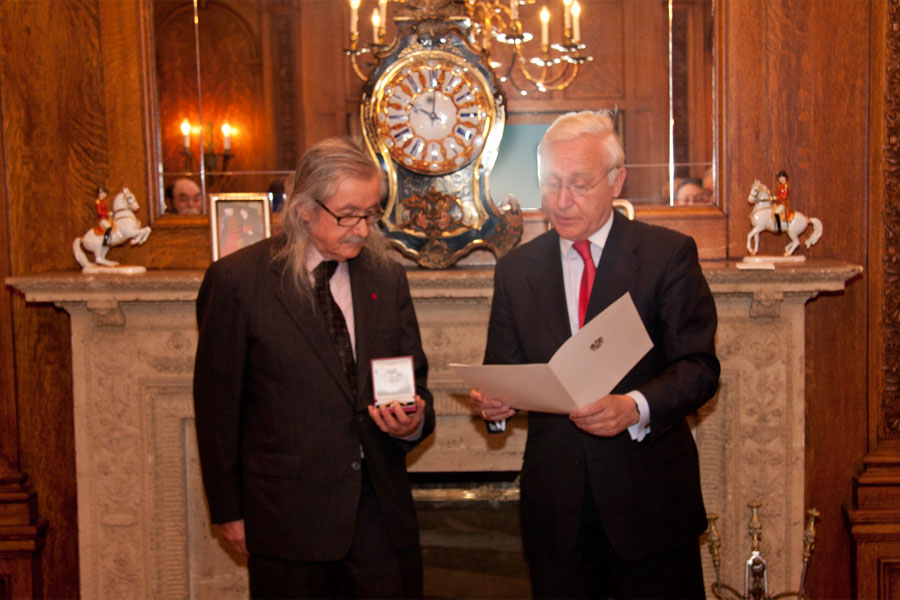
Francis Everitt (left) receiving award
from Austrian Ambassador, Christian
Prosl (right). Click image to enlarge.
On 4 May 2011, prior to the GP-B press conference and public announcement of the experimental results, Principal Investigator, Francis Everitt was awarded the Austian Cross of Honour for Science and Art, First Class. The award was presented by the Austrian Ambassador to the United States, Christian Prosl, at his home in Washington DC. The event was open to the Public, and approximately 50-60 people attended, including a number of current and former GP-B team members from Stanford, NASA and Lockheed Martin.
After Ambassador Prosl talked about the award and presented the medal to Professor Everitt, Professor Everitt gave a short talk about a number of Austrian physicists, including Hans Thirring. In 1918, just two years after Einstein published his general theory of relativity, Hans Thirring and Josef Lense, predicted the so-called "Lense-Thirring" or frame-dragging effect as a corollary to relativity relativity, and while there have been a few other indirect measurements of frame-dragging, GP-B is the first experiment ever to make a direct, controlled experiment of this effect.
About the Award

Regarding the Austrian Cross of Honour, the Wikipedia provides the following brief description and history of this award:
The Austrian Decoration for Science and Art (German: Österreichisches Ehrenzeichen für Wissenschaft und Kunst) is a state decoration of the Republic of Austria and forms part of the national honours system of that country.
History
The "Austrian Decoration for Science and Art" was established by the National Council as an honour for scientific or artistic achievements by Federal Law of May 1955 (Federal Law Gazette No. 96/1955 as amended BGBl I No 128/2001). At the same time, the National Council also established the "Austrian Cross of Honour for Science and Art", which is awarded as "Cross of Honour, First Class" (German: Ehrenkreuz 1. Klasse) and "Cross of Honour" (German: Ehrenkreuz). While not technically counted as lower classes of the Decoration for Science and Art, these crosses are nevertheless affiliated with it.
Divisions
The number of living recipients of the Decoration for Science and Art is limited to a maximum of 72 at any one time (36 recipients for science and 36 for arts). In each of these two groups there are 18 Austrian cititzens and 18 foreign nationals.
Cross of Honour for Science and Art, First Class
There are no limits on the number of recipients.
Cross of Honour for Science and Art
There are no limits on the number of recipients.
March 11, 2010—Francis Everitt and Sir Roger Penrose Awarded 2010 Trotter Prize and Delivered Trotter Lectures at Texas A&M University
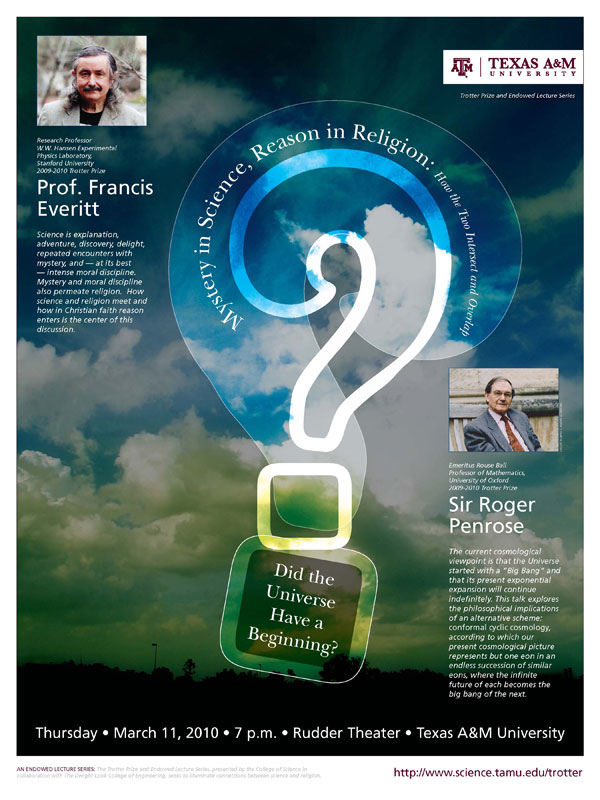
2010 Trotter Prize &
Lecture Poster
(Click to enlarge)
On Thursday, March 11, 2010, two physicists—Francis Everitt from Stanford and Sir Roger Penrose from Oxford—were jointly awarded the ninth annual Trotter Prize at Texas A&M University. The annual Trotter event includes both a cash prize to the recipient(s) and an endowed public lecture series.
The Trotter Prize in Information, Complexity and Inference is awarded annually for pioneering contributions to the understanding of the role of information, complexity and inference in illuminating the mechanisms and wonder of nature.
The Trotter Lecture seeks to reveal connections between science and religion, often viewed in academia as non-overlapping, if not rival, worldviews. For this year’s Trotter Lecture, both Everitt and Penrose spoke on this topic. Everitt’s talk, entitled “Mystery in Science, Reason in Religion,” explored how mystery and moral discipline permeate both science and religion and how reason affects each in the context of Christian faith. Penrose’s talk, entitled “ Did the Universe Have a Beginning?” explored the philosophical implications of conformal cyclic cosmology (CCC), which Penrose offers as an alternative scheme to the prevailing Big Bang theory.
For more information, see:
- Stanford Report, March 9, 2010—The Dish:Stanford People On the Move and In the Spotlight
- Texas A&M News Release
- Texas A&M Trotter Prize & Endowed Lecture Web Page
Fall 2008—GP-B Animations Win 2008 Bronze Telly Award

2008 Bronze Telly Award
Certificate for GP-B Animations
Late in 2006, as we began planning for our first interim GP-B results announcement at the American Physical Society (APS) meeting in April 2007, we realized that a completely new set of computer animations would be very useful to the press and media, as well as members of the GP-B team, in explaining selected scientific concepts and GP-B technological solutions to a public audience. The problem was that the GP-B team at Stanford did not include anyone with computer animation expertise. However, the staff at NASA's Marshall Space Flight Center (MSFC) in Huntsville, AL, (the NASA center managing GP-B) includes a group of professional animators—the UNITeS/Media Fusion animation group. Thus, in order to create these animations, GP-B Public Affairs Coordinator, Bob Kahn and theoretical physicist, James Overduin (author of the Spacetime Tab on this Web site) at Stanford, established a long-distance collaboration with animators Lee Kolb and Greg Trent at MSFC.
The project began with Kahn and Overduin developing a wish list of concepts to be animated. The list, which originally included 8-9 animation sequences, was prioritized and then, due to budget constraints, whittled down to six animation sequences. Working closely with Overduin, Kahn then created detailed storyboards that described both visually and verbally, a sequence of scenes for each animation. Once the storyboards for an animation sequence had been completed, Kahn and Overduin communicated with Kolb and Trent at MSFC using the Internet as a collaborative media for sharing visual concepts and speaker phones for communicating verbally. Kolb and Trent then created preliminary computer animation sequences based on the storyboards they had received from Stanford using state-of-the-art, LightWave 3D animation software from NewTek Corporation. At this point, the Stanford and MSFC team members began an iterative series of weekly telephone conference calls, during which all four participants reviewed and refined each animation sequence, in order to achieve a balance of interesting graphics, scientific and technical accuracy, and proper timing for the scenes within each sequence.
The three top priority animations were completed in time for the GP-B interim results announcement at the April 2007 APS meeting. The collaboration then continued for several more months to complete the remaining three animation sequences. While the storyboards included captions and subtitles for the scenes in each animation (which governed the timing of each scene), the final animations created by Kolb and Trent contained only the image sequences—that is, they contained no captions or subtitles. This was done to enable the animations to be used in situations where a conference presenter or news commentator would talk through the visuals, in which case subtitles could be distracting. However, for the versions displayed on this Web site, Kahn used video editing software to add captions and subtitles, as well as musical soundtracks.
|
Six GP-B Computer Animations—Winners of a 2008 Bronze Telly Award
|
||
|---|---|---|
|
|
|
|
|
|
|
|
Towards the end of 2007, Kolb and Trent decided to enter this series of animations in the 29th annual (2008) Telly Awards contest. As noted on the Telly awards Web site:
"The Telly Awards honor the very best local, regional, and cable television commercials and programs, as well as the finest video and film productions, and work created for the Web. Since 1978, our mission has been to strengthen the visual arts community by inspiring, promoting, and supporting creativity. The 28th Annual Telly Awards received over 14,000 entries from all 50 states and 5 continents."
The results of the 29th annual (2008) Telly Awards were recently posetd on the Web, and we are pleased to announce that the six GP-B animations won a Bronze Telly Award in the Film & Video category. A Telly statue, pictured above-right, is on display in the offices of the animation group at MSFC, and the team received a Telly Award Certificate.
You'll find all of these animations, along with a few others in the first section of our Media Gallery. In addition, thumbnail play buttons for these animations are strategically placed throughout this Web site. We hope you enjoy viewing them, and more important, we hope you find them helpful in explaining the GP-B experiment and some of its scientific and technical concepts.
Spring 2008—Francis Everitt Gives GP-B Talk at Stanford Aero-Astro 50th Anniversary Symposium
Because GP-B is a basic physics experiment that has to be performed in outer space, one of the most essential ingredients to its success over the past 45+ years has been the close collaboration between the Physics and Aeronautics & Astronautics departments at Stanford. For example, one of the critical requirements of the GP-B experiment is that the spacecraft had to fly drag-free in its orbit throughout the experimental (data collection) phase of the mission.
Beginning in the mid 1960s, under the leadership of GP-B co-founder, Robert Cannon, the Stanford Aero-Astro department pioneered the development of drag-free satellite technology, and in the early 1970s, GP-B Co-Principal Investigator, Dan DeBra (now a Professor Emeritus in Stanford’s Aero-Astro Department), led the development, in collaboration with Johns Hopkins Applied Physics Laboratory, of the first drag-free satellite ever flown—the Disturbance Compensation System (DISCOS) drag-free controller for the U. S. Navy’s TRIAD transit navigation satellite, successfully launched in July 1973. Research and development in drag-free satellites and related technologies carried out in the Stanford Aero-Astro Department for GP-B over several decades ultimately led to a number of spin-offs and other applications of these technologies. Also, 65% of the 85 Stanford Ph.D. dissertations concerning various aspects of GP-B over the past 45+ years were written by graduate students in the Stanford Aero-Astro Department under the guidance of Professor DeBra, Professor Bradford Parkinson and the late Professor John Breakwell.
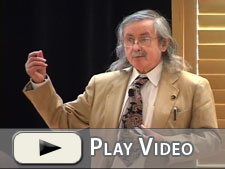
Francis Everitt talks about Aero-Astro
engineering contributions to GP-B
at the 50th anniversary celebration
In May 2008, the Stanford Aero-Astro Department celebrated its 50th anniversary. In honor of this occasion, the department put on a three-day symposium that included over a dozen speakers—including many former Aero-Astro graduates—whose talks looked back over the history and accomplishments of the department, as well as looking forwards towards future goals and frontiers in aeronautics and astronautics.
GP-B Principal Investigator, Francis Everitt, gave one of these talks entitled: Gravity Probe B, the Engineering of a Physics Experiment in Space and the Role of Students in it. In this talk, Everitt traces the history and development of the GP-B experiment and technologies, acknowledging at each step along the way, students and faculty from the Aero-Astro Department who played critical roles in the program. Professor Everitt's 40-minute talk was videotaped, and you can click on the Play Button to the right to view a Flash Video version of this talk. You can also download a PDF copy of the PowerPoint slides that Professor Everitt used during his talk.